The 2026 AI Recruiting Playbook: Ghost Jobs, the Signal Economy, and What Actually Works
Key Takeaways
- 01Recruiting teams are managing 93% more application volume with teams 14% smaller than 2021 (iCIMS, 2025). More inbound volume adds screening work, not signal.
- 0293% of companies admit to posting ghost jobs. Up to 30% of current listings are positions with no genuine near-term hire intent (Resume Genius, 2025). Job seekers and employers are both losing in this system.
- 03Job boards increasingly sell visibility by the click, a model that rewards clicks, not qualified hires. Paying for more of that volume makes the screening problem worse.
- 04Sourced candidates are hired at an 8x higher rate than inbound applicants (LinkedIn Talent Solutions, 2025). AI sourcing platforms are now automating the outreach that used to require a full recruiting desk.
- 05We are operating in a Signal Economy where executive credibility is a direct recruitment asset. 82% of candidates research a CEO's online presence before deciding to join a company (Weber Shandwick, 2025).
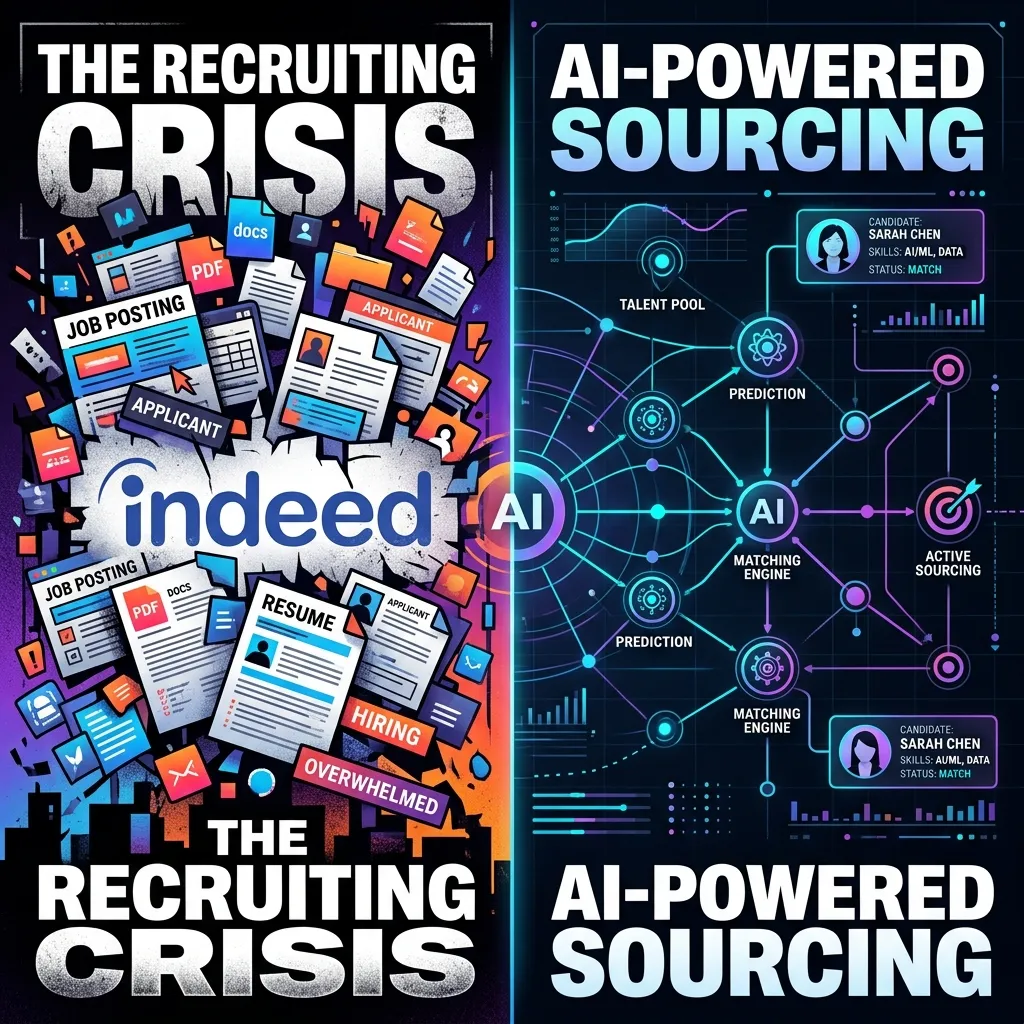
The 2026 talent market in one image: volume without precision on the left, targeted AI sourcing on the right.
Video Walkthrough: Navigating the 2026 hiring crisis and shifting to AI candidate sourcing.
The job market in 2026 is not competitive. It is broken. And it is broken in a specific, documented, measurable way that most companies are still pretending is temporary.
Candidates are applying to hundreds of positions and hearing nothing back. Employers are drowning in applications and still cannot find the right person. Recruiting teams are smaller than they were five years ago and processing nearly twice the volume. And sitting underneath all of it is a job board model that was never designed for this environment and is actively making things worse.
This is the data-backed breakdown of what is actually happening, why the legacy platforms failed, what AI recruiting platforms are doing differently, and why the executives who win the talent market in 2026 will not be the ones who spend more on job boards.
The 2026 Hiring Crisis and the Ghost Job Epidemic
Ghost jobs are job postings published by companies with no genuine near-term intention to hire for the role. They exist to project growth, manage internal employee morale, collect passive resumes, or satisfy procurement requirements. According to research published by Resume Genius (2025), 93% of companies admit to posting ghost jobs, and those postings now account for up to 30% of all active listings at any given time.
The macro context makes this worse. The U.S. economy created approximately 181,000 jobs in 2025, a significant downward revision from the originally reported 584,000 (Bureau of Labor Statistics, January 2026 revision). The headline number most hiring teams were using to calibrate their plans was off by more than 400,000 jobs. The labor market was substantially weaker than the data suggested, and staffing decisions made on that reporting were made on faulty ground.
At the same time, the application volume side of the equation has never been higher. Recruiting teams in 2026 are managing 93% more inbound applications than they were in 2021, with headcount that is 14% smaller (iCIMS Workforce Report, 2025). The result is a system where applicants are filtered out by software before a human ever reads them (see our analysis on Staffing & Recruiting Agency Solutions), and both sides of the market feel like they are failing simultaneously.
2026 Hiring Crisis: By the Numbers
- 93%Share of companies admitting to posting ghost jobs in the past 12 months (Resume Genius, 2025).
- 30%Estimated share of active job listings that are ghost postings at any given time (Resume Genius, 2025).
- +93%Increase in inbound application volume since 2021, against recruiting teams 14% smaller (iCIMS, 2025).
- 181KActual U.S. jobs created in 2025 after revision, versus the 584,000 originally reported (BLS, January 2026 revision).
The modern recruiter's reality: infinite volume, minimal signal, and a job market riddled with listings that were never real.
The hiring crisis is not a candidate quality problem. It is a structural problem. The platforms and practices that dominated talent acquisition for two decades were not built for a market with this ratio of noise to signal. The companies that recognize this and change their approach first are the ones filling roles. Everyone else is still posting and praying.
The End of Post-and-Pray: Why Job Board Economics Broke
Post-and-pray recruiting is the practice of publishing a job listing on a broad-reach job board and waiting for qualified applicants to come to you. It was the dominant hiring strategy for most of the 2010s. In 2026, it is no longer viable, because the free reach it depended on has given way to paying for visibility by the click.
Job boards make their money on sponsored, pay-per-click listings, so an employer that wants its roles seen is increasingly paying for each click rather than relying on free placement. Visibility you rent stops when the budget does, which is why Answer Engine Optimization (AEO) is worth building as a channel for organic authority and visibility.
| The Old Job Board Model | The 2026 Reality |
|---|---|
| Free organic visibility for posted roles | INCREASINGLY REPLACED BY PAID, SPONSORED PLACEMENT |
| Pay for performance (qualified candidates) | PAY-PER-CLICK REWARDS CLICK VOLUME, NOT QUALITY |
| Applicants self-select based on fit | VOLUME OUTRUNS WHAT RECRUITERS CAN SCREEN |
| Employer data stays with the employer | PLATFORM EEO DATA SHARING RISKING COMPLIANCE |
| Scalable for any hiring budget | RISING CPC RATES WITH NO HIRE GUARANTEES |
The structural problem is that a pay-per-click job board business model incentivizes click volume, not hiring outcomes. A sponsored listing that generates hundreds of clicks and no hires is still revenue for the job board. It is a waste for the employer. When recruiting teams are already handling 93% more applications with 14% fewer people (iCIMS, 2025), paying for more inbound applicants is not a solution to the hiring problem. It is an acceleration of the administrative burden that already has recruiting teams underwater.
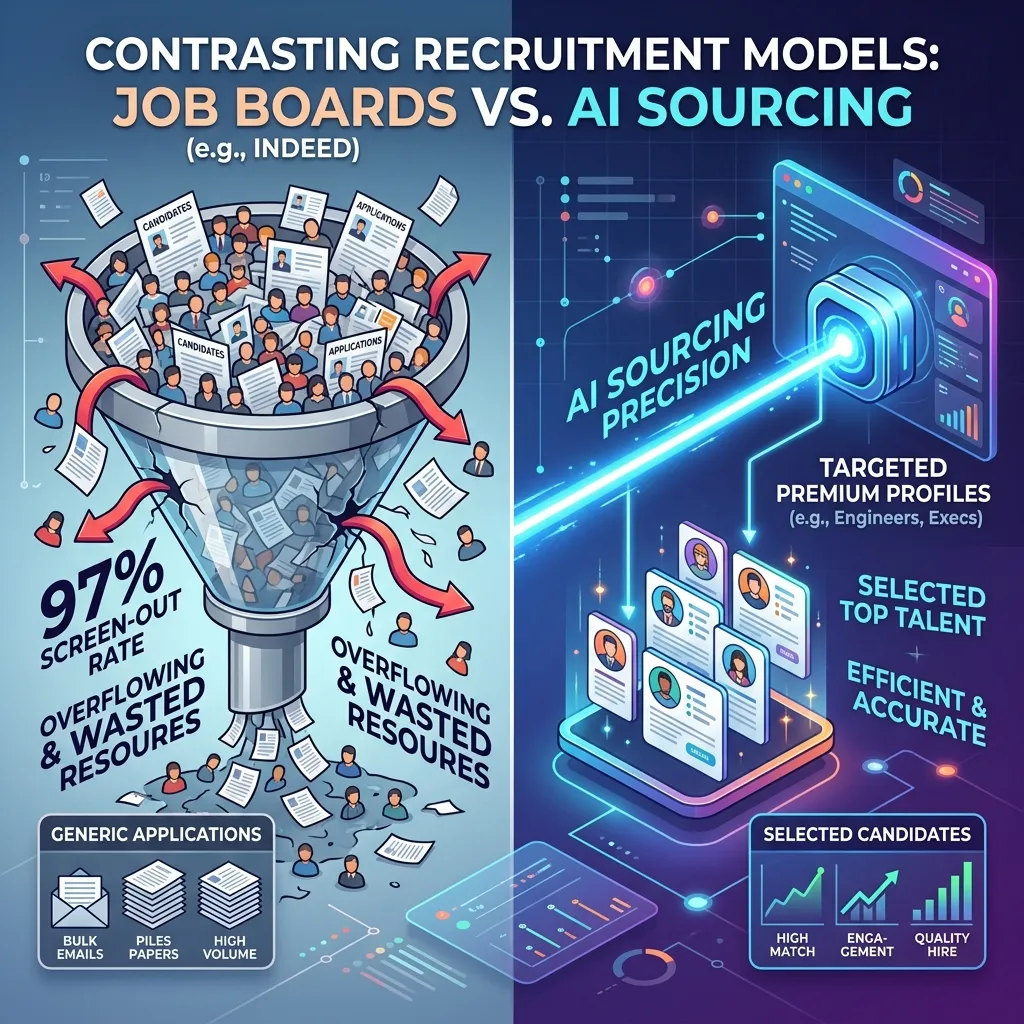
The broken funnel versus the precision model: why broad-reach job boards are losing to targeted AI sourcing in 2026.
The companies searching for Indeed alternatives in 2026 are not doing so because they dislike the platform. They are doing so because the math stopped working. Every dollar spent on job board advertising has a diminishing return when teams cannot keep up with the volume they already get and the underlying market has fewer real roles than the listings suggest. The alternative is not a different job board. It is a fundamentally different approach to finding candidates.
The AI Sourcing Revolution: The 8x Advantage
AI candidate sourcing is the practice of using artificial intelligence to proactively identify, score, and engage passive candidates across public professional networks and databases, rather than waiting for candidates to apply through a job board. Sourced candidates are hired at approximately an 8x higher rate than cold inbound applicants (LinkedIn Talent Solutions, 2025), because they are pre-qualified before the first conversation rather than self-selected from a sea of unfiltered volume.
The platforms building in this space are solving the core problem job boards never addressed: finding the right person before they are actively looking, not competing for attention with every other employer once they are.
AI Recruiting Platforms Changing the Equation in 2026
- PLATFORMGoPerfect says its semantic matching covers 800 million public profiles, which it uses to identify passive candidates aligned to specific role requirements and to start outreach sequences automatically. The platform surfaces candidates that would never appear in a job board applicant pool because they are not actively looking.
- PLATFORMPin uses automated screening and scheduling workflows, which, according to Pin, cut median time-to-hire from 45 days to 14 days. The platform handles the coordination layer that takes up much of a recruiter's time on any given search.
- PLATFORMProHireHQ (our recruiting operating system) addresses structural talent shortages in senior care, home health, and staffing by running fully autonomous sourcing pipelines, including credential verification and compliance checks, around the clock. For industries with chronic candidate scarcity, waiting for inbound applications is not a strategy. It is a vacancy.
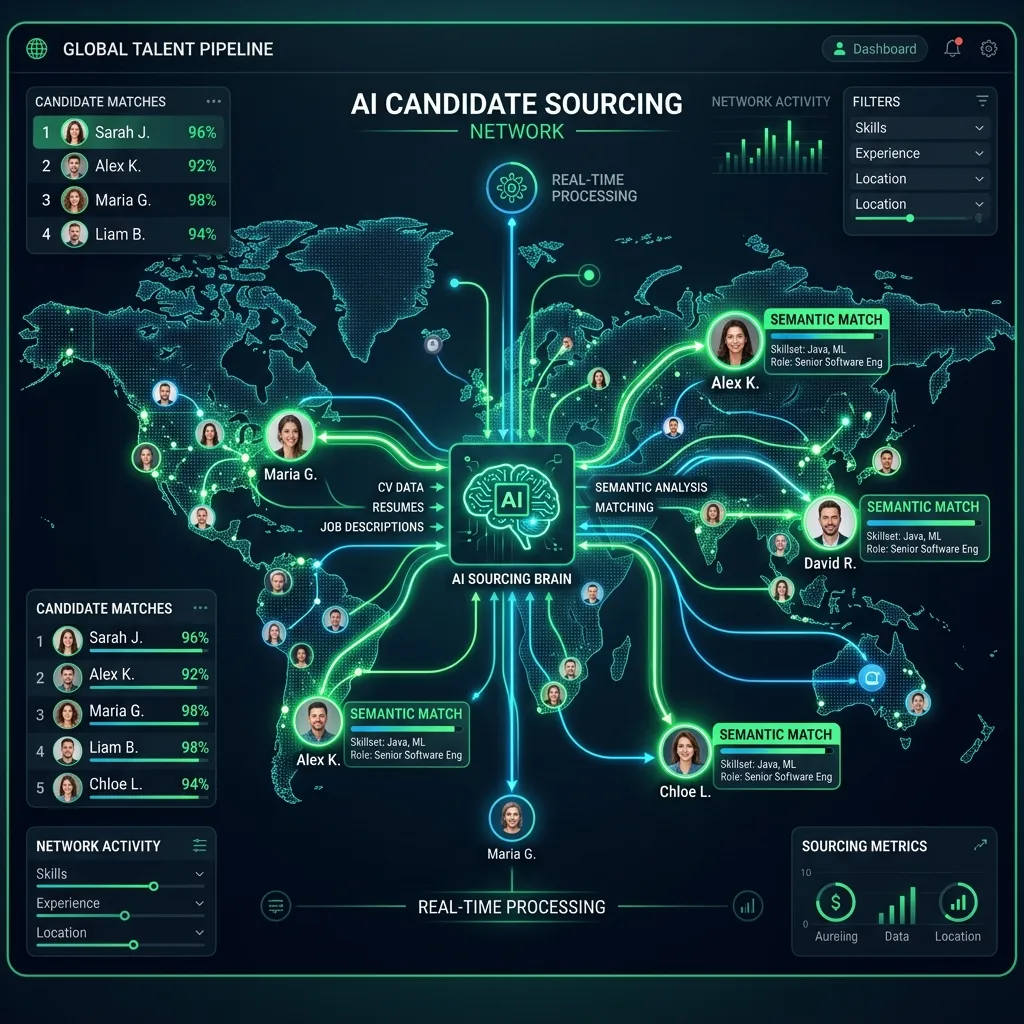
AI sourcing flips the funnel: candidates are identified by fit and engaged proactively, before they enter anyone else's pipeline.
The shift from inbound to proactive sourcing is not a technology preference. It is a response to the math of the current market. If teams are processing nearly twice the applications with fewer people, and up to 30% of the listings they compete with are ghost postings, then optimizing that funnel is a losing game. Sourcing flips the funnel entirely. Instead of filtering down from a hundred unqualified applicants, you are reaching out to three highly qualified ones.
The barrier to proactive sourcing at scale used to be the recruiter hours required to research, identify, and personally reach out to candidates one at a time. AI has removed that barrier. The strategic decision is no longer whether to source proactively. It is which platform to use to do it.
The Signal Economy and CEO Personal Branding as a Talent Tool
The Signal Economy is an environment where content production and attention are cheap, but credibility, trust, and authority compound over time as premium economic assets, the core premise of our Authority Building System. In a market flooded with generic job postings, AI-generated outreach, and companies that look identical at first glance, the executives and organizations that have built genuine authority have a structural hiring advantage that cannot be bought with a bigger job board budget.
The data on this is not soft. Research from Weber Shandwick (2025) found that 82% of employees and candidates research a CEO's online presence before deciding to join a company. It is not enough for the company to have a good reputation. The leader needs to be visible, credible, and findable. For a candidate evaluating two offers at similar compensation levels, the deciding factor is increasingly which company's leadership they can see and trust before they ever walk in the door.
The amplification numbers on LinkedIn make the ROI clear. Data from Richard van der Blom's LinkedIn Algorithm Report (2025) shows CEOs and executives generating the same number of reactions as their company's page using just 1.67% of the follower count. Personal authority outperforms corporate broadcasting by a factor of roughly 60x on an engagement-per-follower basis. Every post a CEO publishes is a recruitment asset.
The 40-Minute CEO Personal Brand Framework
Executive visibility does not require a content team or an hour a day. This five-step framework requires 40 minutes of the executive's time per month and can be executed by a single team member or operator.
- 01Insight Collection: A 10-minute recorded conversation or voice note where the executive shares a current observation, opinion, or decision point from the past week. Raw thinking, not polished content.
- 02Refine Thoughts: Operator distills the raw insight into a structured point of view with supporting data, a clear takeaway, and a relevant hook. No executive time required.
- 03Content Creation: Three to five LinkedIn posts drafted from the refined insight. Operator formats, writes, and schedules. Executive has not touched a keyboard yet.
- 04CEO Polish: Executive reviews drafts in 15 to 20 minutes, adds voice corrections, approves. One sitting, once a month.
- 05Publish and Compound: Content goes live on a consistent schedule. Authority builds cumulatively. Each post is a standing recruitment asset that continues generating candidate trust long after it is published.

In the Signal Economy, authority is a recruitment asset. The executive's visible credibility attracts candidates that no job board can reach.
The practical implication for talent acquisition leaders is this: if the CEO of your company has a dormant LinkedIn profile with a headshot from 2019, you are leaving a significant recruitment lever unpulled. Candidates who are evaluating your offer against a competitor's are going to search that name. What they find, or do not find, affects acceptance rates.
Building executive visibility is not a vanity project. In the Signal Economy, it is a structural competitive advantage in the war for talent. The companies that understood this early are already compounding the returns. Everyone else is still trying to fix their Indeed account.
The Playbook for 2026
The talent acquisition leaders who are winning in 2026 have stopped optimizing a broken system. They are not spending more on Indeed. They are not posting more ghost jobs. They are not asking their recruiting teams to process more volume with fewer people.
They shifted to proactive AI sourcing that finds qualified candidates before the competition does. They built executive visibility that gives candidates a reason to choose their company before the offer conversation begins. And they stopped treating hiring as a volume funnel problem and started treating it as a signal and trust problem.
The market is not going back to the way it worked in 2019. The platforms that dominated that era are already charging more for worse results. The infrastructure for a better approach exists now and is accessible to companies of every size. The only question is how long your organization is going to wait before using it.
Done Competing on Job Boards That Aren't Working?
We work with service businesses, staffing firms, and growth companies to build talent acquisition systems that do not depend on platforms that have stopped performing. AI sourcing, authority building, executive visibility. Tell us where you are stuck and we will tell you what to fix first.
Frequently Asked Questions
Why are recruiting teams overwhelmed in 2026?
Recruiting teams are managing 93% more application volume than in 2021 while operating with teams 14% smaller (iCIMS Workforce Report, 2025). More inbound volume adds screening work without adding signal, so qualified candidates get harder to find, not easier.
Why are recruiters moving away from Indeed in 2026?
Recruiters are moving away from Indeed because pay-per-click pricing rewards clicks rather than hires, and it brings high volumes of unqualified applicants to teams that are already stretched: recruiting teams are managing 93% more application volume than in 2021 with 14% fewer people (iCIMS Workforce Report, 2025). Buying more broad-funnel traffic adds to that workload instead of solving it.
How does AI candidate sourcing work?
AI candidate sourcing platforms proactively scan hundreds of millions of public profiles to identify, score, and automatically message passive candidates who match specific job requirements. GoPerfect, for example, says its semantic matching covers 800 million profiles, which it uses to surface and engage talent that would never apply through a job board because they are not actively looking.
How many job postings are ghost jobs in 2026?
Up to 30% of current job listings are ghost jobs, meaning positions companies post without genuine near-term intent to hire, and 93% of companies admit to posting ghost jobs (Resume Genius, 2025). Companies use them to project growth, manage employee morale, or build a passive resume database.
What is the Signal Economy in recruiting?
The Signal Economy is an environment where content production and attention are cheap, but credibility, trust, and authority compound as premium economic assets. In recruiting, it means that a CEO's or executive's personal brand on LinkedIn now functions as a direct talent acquisition tool. Weber Shandwick (2025) found that 82% of employees and candidates research a CEO's online presence before deciding to join a company, making executive visibility a measurable hiring advantage.