How to Get Your Service Business Recommended by ChatGPT and Perplexity: The AEO Playbook
What Is Answer Engine Optimization for Service Businesses?
Answer engine optimization (AEO) is the practice of structuring your website content so that AI systems like ChatGPT, Perplexity, and Google AI Overviews pull your business as a direct answer to a customer query, not just as a link in the results. For a law firm, a pest control company, a staffing agency, or a home health clinic, that means showing up inside the AI response itself when someone asks who provides the best version of your service.
AEO is not a replacement for SEO. It is the layer on top of it that determines whether you get cited by AI or ignored by it. With ChatGPT surpassing 883 million monthly users (OpenAI, 2026), the AI recommendation slot is now a place your buyers are looking, whether or not you are there.
This playbook covers all four pillars: technical crawlability, the GEAF content structure, off-site authority signals, and measurement. Build them in order. The businesses getting cited by AI right now did not get lucky. They got structured.
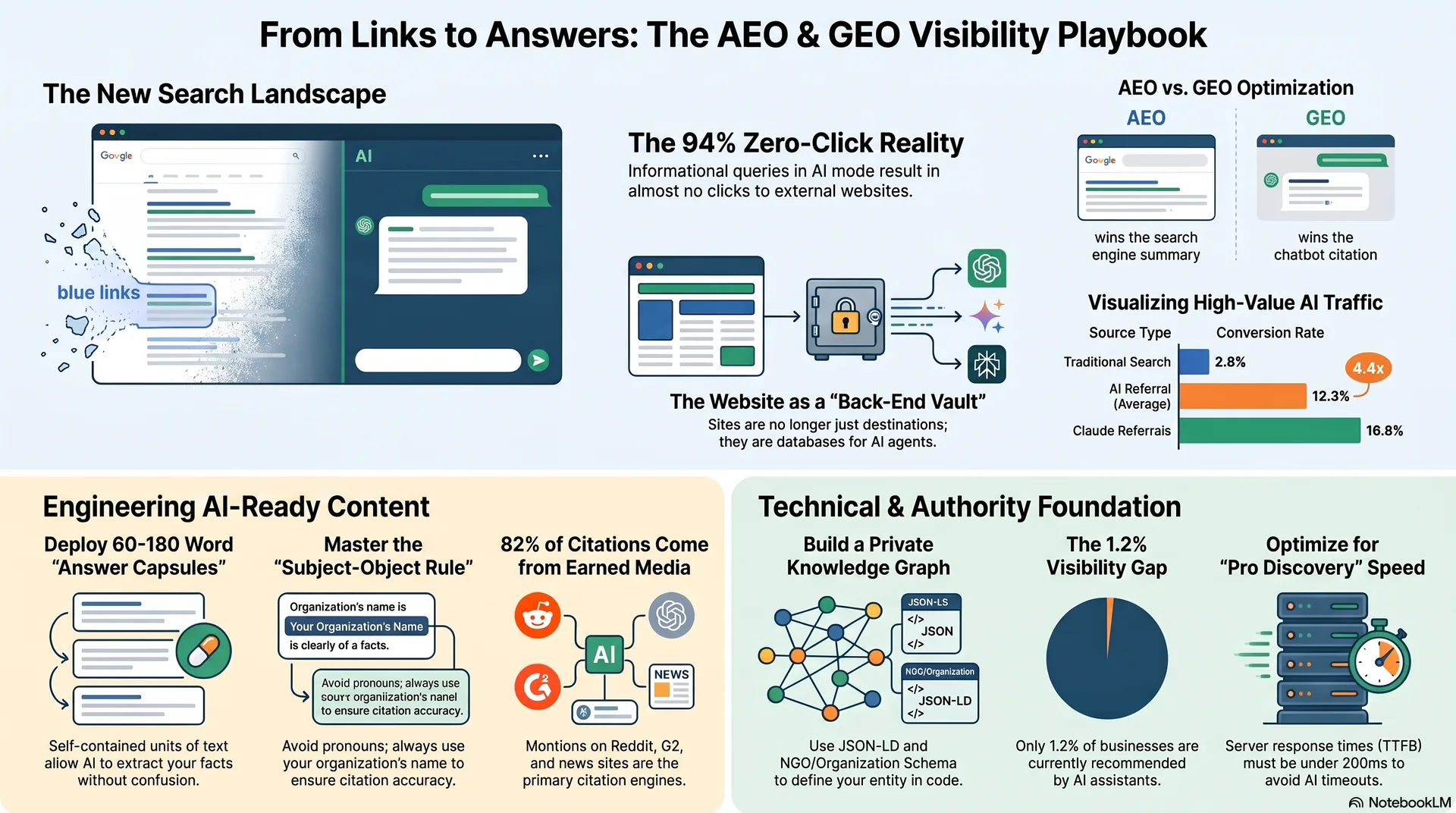
Video Walkthrough: Getting your business recommended by ChatGPT and Perplexity.
The Search Shift Nobody Warned Your Marketing Agency About
For two decades, the goal of every marketing dollar in the search channel was the same: rank higher, get to page one, beat your competitor to the top of Google. That game produced an entire industry of SEO agencies, keyword trackers, and backlink audits. It worked because the search result page was the final stop before the click.
That destination moved, and most service business owners have not been told.
When a potential client asks Perplexity “what is the best staffing agency for home health in Virginia Beach,” (an inquiry handled by our Healthcare Recruiting Engine or Nurse Staffing Solutions), they do not see ten blue links. They get a direct answer that names specific companies, explains why those companies fit the criteria, and provides contact information. The user reads it, picks up the phone, and calls. Your position on Google page one was never consulted. It did not exist in that transaction.
This is not a future problem. BrightEdge research published in Search Engine Journal and other publications found organic click-through rates dropped 18% year over year as AI Overviews absorbed the intent that used to drive clicks. For local and regional service businesses (like the Hampton Roads market we serve through our Virginia Beach AEO agencyhub), the erosion is faster because service queries (“who can fix my HVAC,” “find me a recruiter,” “best pest control near me”) are precisely the type AI models are most trained and confident to answer without sending the user anywhere.
The question is not whether AI is changing how your customers find you. It already has. The question is whether your digital presence is built to be extracted as an answer or passed over in favor of a competitor who built theirs that way.
AEO is the practice of making sure AI picks you. (Read our comprehensive breakdown of Answer Engine Optimization (AEO) Systems to see how we build this for clients). Here is exactly how it works.

The Search Shift: from ranking to recommendation. AI now answers before the user clicks anything.
The Technical Foundation: Passing the Bot Checkpoint Before Any Content Matters
Before any AI model can recommend your business, it has to successfully crawl and parse your site. This requires a rock-solid technical core, which we deploy for clients via our Website Foundations and Website Authority Foundations frameworks. Most service business websites fail this checkpoint before the content conversation even begins. GPTBot, PerplexityBot, and ClaudeBot are not patient. They make a decision about your page in milliseconds. If the signals are wrong, they move on and cite whoever they find next.
There are five checkpoints. Pass all five. There is no partial credit.

The Technical Bot Checkpoint: five gates every AI crawler evaluates before deciding whether to index your page.
Technical AEO Checkpoint: Pass or Fail
- PASSPage Speed:A low Time to First Byte, and Largest Contentful Paint under 2.5 seconds, which is Google’s “good” threshold for Core Web Vitals. Crawlers like PerplexityBot and GPTBot fetch pages quickly and move on, so a slow server makes your content harder to retrieve. Check PageSpeed Insights now before reading further.
- PASSrobots.txt Access: GPTBot, PerplexityBot, and ClaudeBot must not be blocked. Open
yoursite.com/robots.txtright now. If you seeDisallow: /under any of those agents, you are invisible to AI crawlers by your own hand. - PASSSchema Markup: JSON-LD structured data that tells crawlers what type of business you are, what you offer, where you are, and who runs it. At minimum: LocalBusiness, Service, and FAQPage schema on every relevant page. Without proper schema integration (built natively in our Website Authority Foundations), AI models treat your content as unclassified text.
- PASSClean Heading Hierarchy: One H1 per page containing your primary keyword. H2s for major sections. No skipped heading levels. AI models use heading structure to parse topic relevance and determine what a page is actually about. A broken heading hierarchy reads as a disorganized document and gets skipped.
- PASSImage Optimization: All images compressed, served in WebP, with keyword-rich descriptive alt text. AI crawlers treat alt text as semantic content on par with body copy. File names matter too:
pest-control-virginia-beach-technician.webptells an AI model something.IMG_0047.jpgtells it nothing.
Run PageSpeed Insights and the Schema Markup Validator at schema.org before doing anything else with content. A broken technical foundation means every hour spent on content strategy is wasted. Fix the foundation first.
Content Engineering: The GEAF Framework
Most service business websites are written entirely for humans. Long narrative paragraphs, conversational copy, a services list, some testimonials. That content performs reasonably well for Google rankings. It performs poorly for AI citation because there is no extractable answer block. The AI scans the page, cannot find a clean, self-contained answer to the query it is trying to resolve, and moves to a page that has one.
The GEAF framework (Generative Engine Answer Framework) solves this. It is a four-layer content structure designed so that AI crawlers can extract a direct, citable answer from your page, while human readers still get a complete, engaging article. You do not have to choose between writing for AI and writing for people. You structure for AI and write for people.
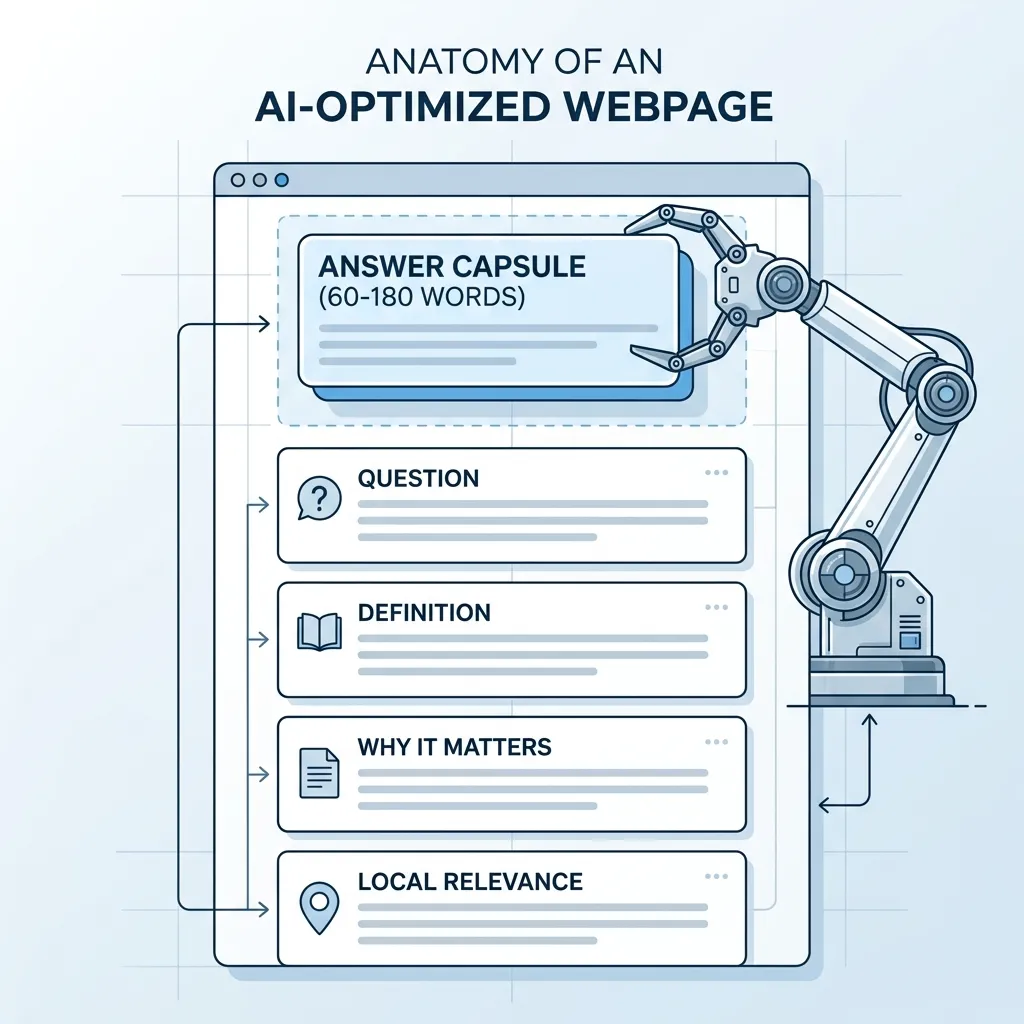
The GEAF Framework: four content layers that make your page extractable by AI and readable by humans.
Layer 1: The Answer Capsule
A 60 to 180 word block at the top of the page that directly and completely answers the most likely question a visitor brings to it. Self-contained means that an AI model can pull this block and use it as a standalone citation without reading the rest of the page. Do not tease the answer. Do not save it for the conclusion. Lead with the full answer, then support it. This is the block ChatGPT, Perplexity, and Google AI Overviews are designed to find first. If it is not there, they move to the next page.
Layer 2: Fact Blocks
Structured lists, comparison tables, numbered steps, and bulleted checklists. AI models are trained to treat structured data as high-confidence extractable information. A bulleted list of “what to look for in a home health staffing agency” is more likely to be cited verbatim by Perplexity than a paragraph making the same points in narrative form. Every page should have at least two fact blocks. They also double as the most-shared, most-linked content format for human readers, so they serve both audiences.
Layer 3: Supporting Narrative
Your regular body copy. Explain the concepts, provide context, tell the story, demonstrate expertise. This layer is primarily for human readers and for topical authority signals that influence how AI models rank source reliability. Write it at a natural reading level. Do not keyword-stuff it. The goal here is genuine depth on the topic, which signals to AI crawlers that your page has earned its place as a reference source.
Layer 4: FAQ Section
A minimum of four Q&A pairs with FAQPage JSON-LD schema attached. Each answer must lead with the direct answer, followed by one or two supporting sentences. This layer captures the long-tail conversational queries that people type into ChatGPT, which you would never have targeted with traditional SEO because the search volume on any single variation is too low to register. Write the questions the way your actual customers ask them on the phone, not the way a marketer would phrase a keyword.
Off-Site Authority: The AI Trust Hierarchy
Here is the part most AEO guides skip because it is harder to package into a product: AI models do not only read your website. They are trained on and actively crawl a web of third-party sources. Review platforms. Industry databases. Community forums. Reddit. What those external sources say about your business carries more weight with AI than what you say about yourself on your own pages. (For example, our Review Authority System is designed specifically to feed AI models positive sentiment signals on high-weight review sites).
Your own content makes you a candidate. Third-party validation makes you a recommendation. AI models are doing the same thing a referral-based buyer does: checking whether people they have reason to trust agree with your self-assessment. If the external corroboration is thin, your on-page AEO work is building on sand.
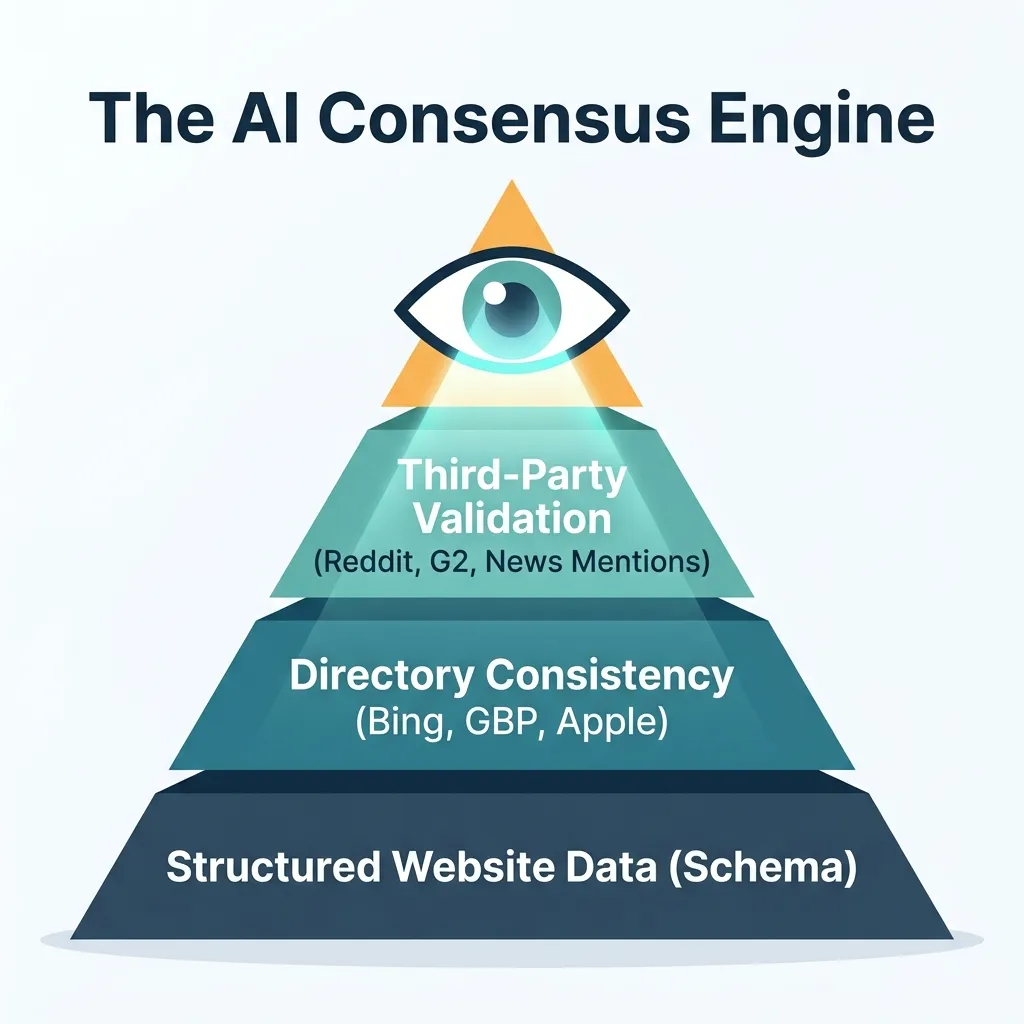
The AI Trust Hierarchy: our working view of which external sources matter most when AI decides who to recommend.
The ratings below are our own rule of thumb from doing this work, not weights published by OpenAI, Google, or Perplexity. None of them disclose how their models rank sources.
| Signal Source | Our Rule of Thumb | What to Do |
|---|---|---|
| Google Business Profile reviews | Very High | A steady flow of genuine, detailed reviews, with owner responses that mention the service. Scale reviews with our Review Authority System on ProactiveCRM.ai. |
| Reddit mentions | Very High | Genuine brand mentions in relevant subreddits. Cannot be manufactured. Earn them organically. |
| G2, Clutch, Capterra, Healthgrades | High | Complete profile. Verified reviews describing specific outcomes. Part of building your Employment Brand Authority. |
| Industry directories (BBB, Angi, Yelp) | High | Complete profiles with consistent NAP (name, address, phone). Mapped during our Local Brand Authority setup. |
| Trade publications and niche press | Medium | Expert quotes, guest articles, or commentary in publications your buyers read. Mapped via the Authority Accelerator. |
| LinkedIn company page | Medium | Current, keyword-aligned description, accurate employee count, regular updates. |
| Your own website | Lower (unverified) | Necessary. Never sufficient alone. What you say about yourself carries less weight than what others say about you. Ensure it has perfect Website Foundations. |
The practical play is not complicated. Ask your best clients for detailed reviews on Google and the top platform in your vertical. Make it easy for them. Send a direct link. List your business on every relevant directory with a complete, keyword-aligned profile. Pursue one or two trade publication mentions per quarter. Respond to every review, positive and negative, with substantive replies that include your service and location keywords naturally.
The compounding effect of this work takes months, not weeks, to show up in AI citations. But it is also the hardest part for competitors to replicate quickly, which is exactly why it is worth building now.
Tracking the Unseen: How to Measure AEO Results
Most AEO guides end here with a shrug because AI citation measurement is still early and no single platform gives you a complete picture. That is true. But “hard to measure perfectly” is not the same as “impossible to track directionally.” Here are four methods that give you real signal right now.
Four measurement methods that produce real AEO signal before dedicated tracking tools mature.
1. Manual AI Query Audits (Weekly, 20 Minutes)
Run your top 10 to 15 service queries directly in ChatGPT, Perplexity, Google AI Overviews, and Claude. Log which queries return your business as a citation and which return competitors. Do this weekly in a simple spreadsheet. Over 60 days, you will have a clear picture of which queries you own, which you are losing, and which moved after you made content changes. This is the most direct AEO feedback loop available.
2. Perplexity Referral Traffic in GA4
Perplexity links to its cited sources. That means when Perplexity recommends your business, you receive measurable referral traffic. In Google Analytics 4, filter your Acquisition report by source and look for perplexity.ai as a referring domain. Growth in that channel is a direct, quantifiable AEO metric. Set a monthly baseline and track it.
3. Brand Mention Monitoring
Tools like Brandwatch, Mention, and Google Alerts track when and where your business name appears across the web. An increase in unlinked brand mentions on third-party sites, forums, directories, and trade press is a leading indicator of growing AI citation eligibility. Authoritas and Semrush are both building LLM visibility tracking modules as of mid-2026. Worth setting up now so the baseline data exists when those tools mature.
4. Branded Search Volume in Google Search Console
When AI models recommend your business by name, a portion of those users then search for you on Google to verify, find your number, or visit your site directly. In Google Search Console, monitor impressions and clicks for queries that contain your business name. An upward trend in branded search volume is a downstream signal of AI citation activity that you cannot see directly but can measure through its effect.
The Window Is Open. Not Forever.
AEO is not a trend that is arriving. It is already deciding which businesses get called and which ones get passed over. The service business owner who spent 2024 perfecting their Google Ads strategy is now competing with AI-surfaced recommendations that bypass the ad platform entirely and reach buyers before they ever get to a search results page.
The good news is that none of this needs a large budget or a large website. A pest control company, a staffing firm, a law office, or a home health clinic with solid technical structure, GEAF-formatted content on its core service pages, and genuine off-site authority built from real reviews and real mentions is in a position to start earning AI citation slots. The businesses doing this work right now are building a moat that will be expensive and slow for everyone else to cross later.
Build the foundation. Structure the content. Earn the citations. That is the entire playbook. The recommendation slot belongs to whoever shows up prepared.
Want Us to Audit Your AEO Readiness?
We run a full AEO audit across your technical setup, content structure, and off-site signals and hand you a prioritized fix list specific to your business. No generic reports. No upsell to a retainer. Just a clear picture of what is keeping you out of the AI recommendation slot and what to fix first.
Request Your AEO AuditFrequently Asked Questions
What is answer engine optimization (AEO)?
Answer engine optimization is the process of structuring your website content so AI systems like ChatGPT, Perplexity, and Google AI Overviews extract your business as a direct answer to user queries rather than listing you as a link to click. For service businesses, AEO means showing up inside the AI response itself when a potential customer asks who provides the best version of your service in your area.
How long does AEO take to produce results for a service business?
There is no fixed timeline. It depends on how often AI crawlers revisit your site, how competitive your service and area are, and how much off-site authority you already have. Technical fixes and Answer Capsule content can be done in weeks. Off-site authority from reviews and third-party mentions builds over months. Track progress with weekly manual query audits rather than waiting on a date.
Do I need a large website to get recommended by ChatGPT?
No. A single well-structured service page with an Answer Capsule, proper schema markup, and strong third-party mentions on platforms like Google Business Profile and relevant industry directories can get a small service business cited by AI search engines. Volume of pages does not matter. Structure and external validation do.
What is the GEAF framework?
GEAF stands for Generative Engine Answer Framework. It is a four-layer content structure built for AI crawlers: an Answer Capsule at the top, Fact Blocks for structured data extraction, supporting narrative for depth and authority, and a FAQ section for long-tail conversational queries. Every layer serves both the human reader and the AI model trying to extract a citable answer from your page.
How do I track whether AI is recommending my business?
Run manual query audits weekly by searching your top service queries in ChatGPT, Perplexity, Claude, and Google AI Overviews and logging the results. Monitor your Google Analytics acquisition report for perplexity.ai as a referral source. Watch branded search impressions in Google Search Console for upstream signal of AI recommendation activity. Set up brand mention alerts via Brandwatch or Google Alerts to track third-party coverage growth.
Related Reading
- The 2026 AI Recruiting Playbook: Ghost Jobs, the Signal Economy & What Actually Works
- Our Answer Engine Optimization (AEO) Services: Get Recommended by AI
- AI Automation for Service Businesses: What Actually Works in 2026
- The Authority Building System: Why Being Recommended Beats Being Found
- More from the Build Don't Beg Blog