How to Start a Recruiting Business Without Begging for Your First Client
If you are a producing recruiter wondering how to start a recruiting business of your own, here is the honest version from someone who did it. I started recruiting in 2009 and opened my own firm in 2022. The legal setup is the easy part. Building a client pipeline that does not depend on you dialing all day is the hard part, and it is the part most people skip.
Most recruiters who go out on their own copy the desk they just left. Same cold calls, same job board posts, same chasing. That is begging with a new logo. This guide covers the paperwork, but it spends most of its time on the part that decides whether you make it: building a business that clients find, trust, and call.
The short answer
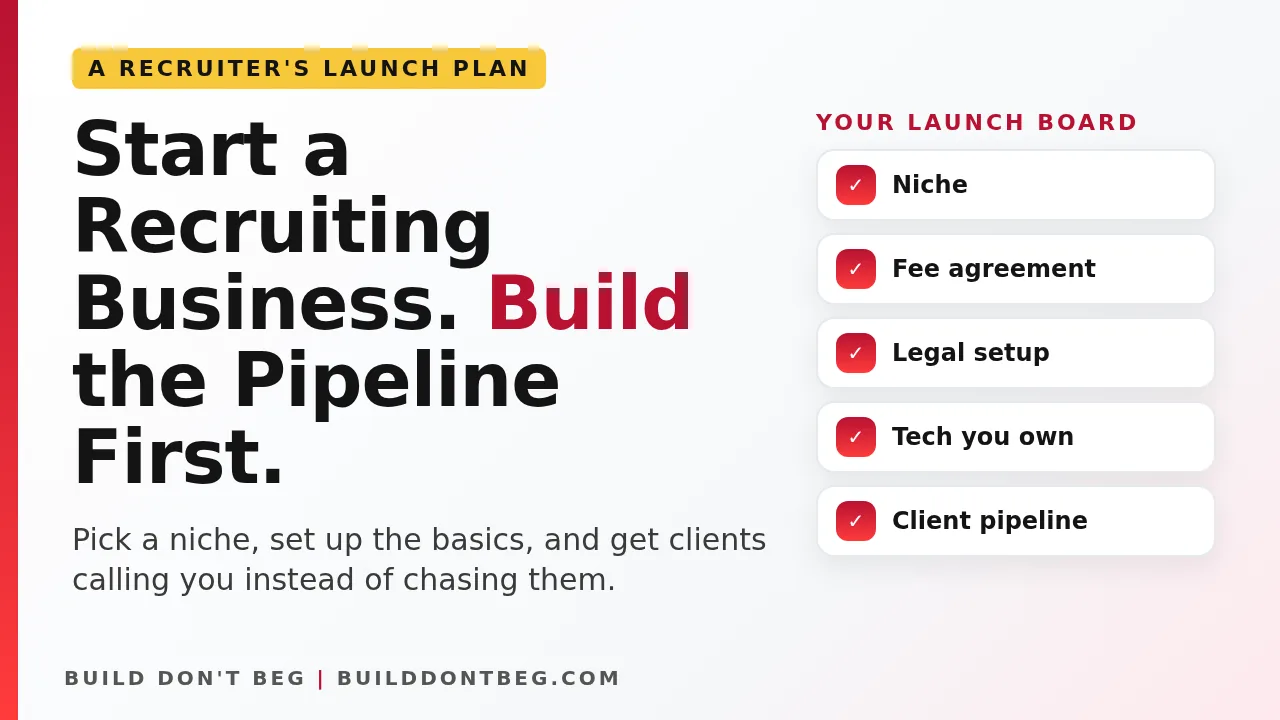
To start a recruiting business:
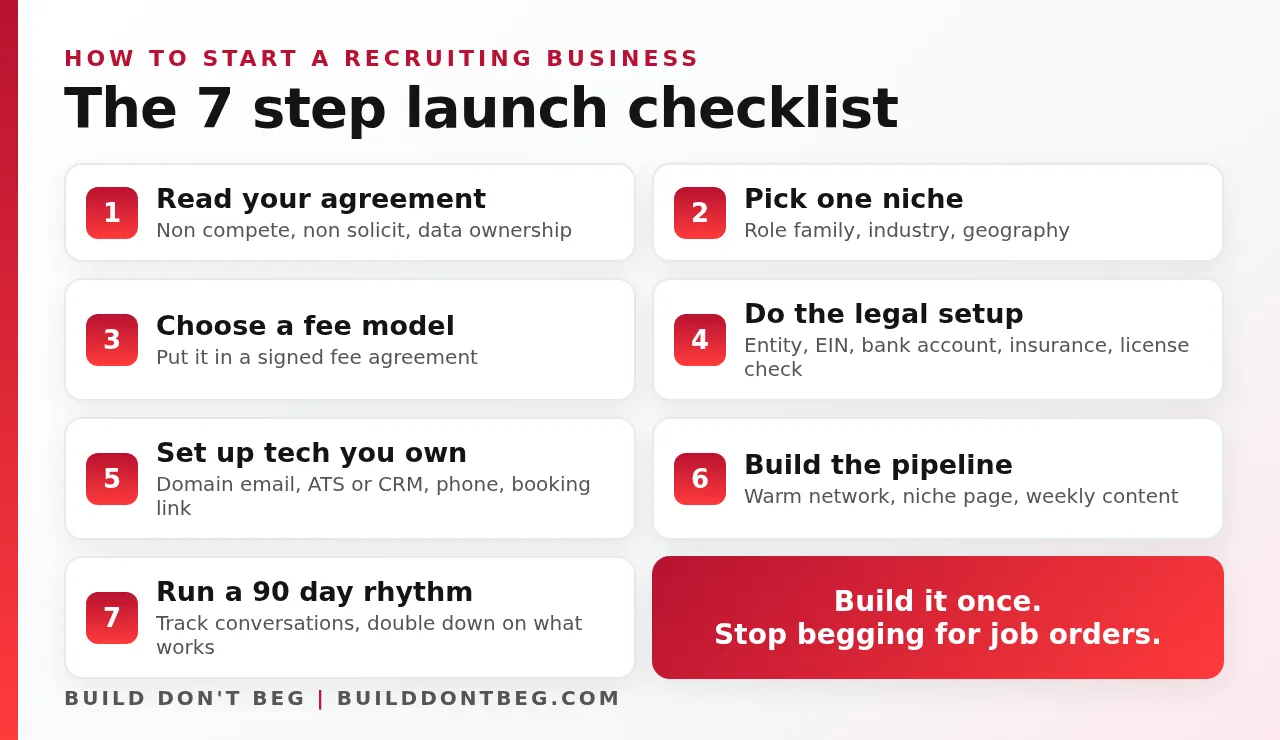
- Read your current employment agreement before you resign.
- Pick one niche you can be known for.
- Decide how you get paid and put it in a written fee agreement.
- Form a legal entity, get an EIN, open a business bank account, and get insured.
- Set up a small tech stack that you own: domain email, an ATS or CRM, a business phone line, and a booking link.
- Build your client pipeline before you need it: warm relationships, a niche page, and a weekly content habit.
- Run a simple weekly rhythm for 90 days, then fix what is not working.
The rest of this article walks through each step and the mistakes I see most.
Step 1: Read your agreement before you quit
Before you tell anyone your plans, pull out the agreement you signed with your current firm. Look for three things:
- Non compete language. Does it limit where or for whom you can recruit after you leave, and for how long?
- Non solicitation language. Does it stop you from contacting the firm's clients or candidates?
- Data ownership. Your current firm almost certainly owns its database. Do not export it, forward it, or photograph it on the way out.
Rules on these clauses vary by state and change over time, so spend the money on an hour with an employment attorney in your state. It is the cheapest insurance you will buy all year, and it lets you start clean instead of starting with a dispute.
Step 2: Pick a niche you can be known for
New firms fail as generalists. When you recruit "anything," no employer has a reason to call you instead of the dozen other recruiters already in their inbox.
A good niche is narrow enough that people can repeat it in one sentence. Pick it by combining:
- A role family you already understand, such as nurse leaders, controllers, or field service technicians.
- An industry where those roles are hard to fill.
- A geography, if the roles are local.
Here is a quick test I use: can you name 50 employers who hire this role, and do you know what a great candidate looks like without googling it? If yes, you have a niche. If not, keep narrowing.
Why the niche matters for marketing
A niche is not just a sales decision. It is what makes your content, your website, and your reputation compound. Every article, every market update, and every placement in the same niche makes the next client easier to win. That is the whole idea behind the Build vs Beg operating system: build assets that keep working, instead of starting from zero with every call.
Step 3: Decide how you get paid
Most new recruiting businesses start with one of these models:
- Contingency. You get paid a fee only when the client hires your candidate. Easy to sell, but you carry all the risk.
- Retained. The client pays part of the fee up front to engage you on a search. Harder to sell on day one, but it filters out clients who are not serious.
- Engaged or container search. A smaller commitment fee up front, with the balance at placement. A middle ground many independent recruiters use.
- Contract staffing. You place people on temporary assignments and bill hourly. This is a different business. You become the employer of record, which means payroll, workers' comp, and the cash to cover wages before clients pay you.
Whichever you pick, put it in a signed fee agreement before you send a single resume. At a minimum it should cover the fee and when it is due, the replacement guarantee, how long a candidate you introduced stays "yours," and what happens if the client hires your candidate for a different role.
Step 4: Handle the legal and admin setup
This part is not hard. It just has to be done in order.
Form your business entity
Most solo recruiters form an LLC, but talk to an accountant about what fits your situation. The SBA has a plain guide to choosing a business structure, and your state's secretary of state website handles the filing.
Get an EIN
An Employer Identification Number lets you open a business bank account and handle taxes. The IRS issues it online, and an EIN is free from the IRS. Ignore any website that tries to charge you for one.
Open a business bank account and get insured
Keep business money separate from day one. Then look at insurance. Professional liability (errors and omissions) is the one recruiters ask about most, and general liability is common too. The SBA lays out the main types in its guide to business insurance.
Check whether you need a license
Some states and cities license employment agencies. New York City, for example, requires an Employment Agency license for businesses that help employers find employees for a fee. Rules depend on where you operate and how you charge, so check your state and city before you take your first search. The SBA's page on licenses and permits is a good starting point.
Step 5: Set up a small tech stack you own
You do not need much on day one. You do need to own all of it.
- A domain and domain email. Clients take you more seriously at yourname@yourfirm.com than at a free email address.
- An ATS or CRM. One place for candidates, clients, notes, and follow up tasks. If it is not in the system, it did not happen.
- A business phone number that can text. Keep your personal number personal.
- A booking link. Let clients and candidates grab time without five emails back and forth.
- A clean LinkedIn profile that says who you help in your niche, not just "Recruiter."
The rule that matters: the accounts, the data, and the phone numbers are in your name. If a vendor or contractor ever holds them for you, get it in writing that you can export everything and leave.
Step 6: Build your client pipeline before you need it
This is where most new recruiting businesses stall. The founder spends the first month on logos and business cards, then realizes nobody is calling. So they go back to dialing for dollars, and the business becomes a job with worse benefits.
Build the pipeline in three layers.
Layer 1: Warm relationships
Start with people who already know your work: hiring managers you have helped, candidates you placed who now hire, and peers in your niche. Respect your non solicitation terms, but do not be shy about telling your network what you are doing and who you help. A short personal note beats a mass announcement every time.
Layer 2: Become the answer in your niche
Employers search before they call. Increasingly they also ask AI tools like ChatGPT who to work with. You want your firm to show up in both places. That means:
- A niche page on your site that explains exactly which roles you fill, where, and how your process works.
- A weekly piece of useful content: a market update, a salary trend you are seeing, or an answer to a question hiring managers keep asking you.
- Consistent proof: what you do, for whom, explained the same way everywhere.
If you want the playbook for this, start with SEO for recruiters and then read how to rank in ChatGPT. Both are written for people who would rather be found than chase.
Layer 3: Outreach that is not begging
Outreach still has a place. The difference is what backs it. "Do you have any openings?" is begging. "I am speaking with a strong candidate in your market and thought of you" or "Here is what I am seeing on pay for this role in your city" is value. Lead with a candidate, a market insight, or a useful resource, and follow up on a schedule your CRM reminds you about.
Step 7: Run a 90 day rhythm
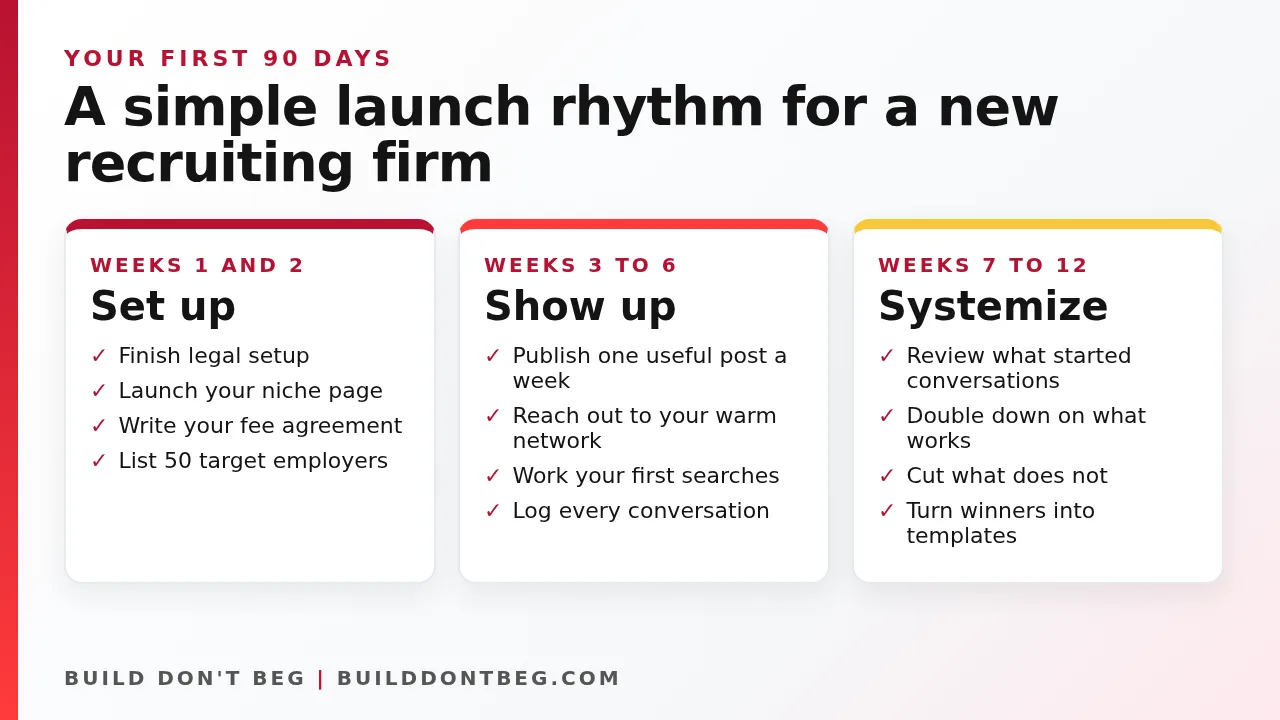
The first 90 days are about habits, not perfection. Here is the rhythm I recommend:
- Weeks 1 and 2: Finish the legal setup, launch your niche page, write your fee agreement, and list your first 50 target employers.
- Weeks 3 to 6: Publish one useful piece of content every week, reach out to your warm network, and work your first searches.
- Weeks 7 to 12: Review what actually created conversations. Double down on that, cut what did not, and turn your best emails and posts into templates.
Track a few simple numbers every week: conversations with hiring managers, searches opened, candidates submitted, and interviews scheduled. If conversations are low, the problem is your pipeline, not your closing.
Mistakes I see recruiters make going independent
- Staying a generalist because a niche feels limiting. It is the opposite.
- Working without a signed fee agreement because the client "seems nice."
- Renting the whole pipeline from job boards and paid lists, with nothing you own building underneath.
- Quitting with no runway. Placements take time to close and invoices take time to pay. Plan your personal finances for that gap before you resign.
- Treating cold calling as the only engine. It can open doors early, but if it is all you have, you will burn out before the business compounds.
Where coaching fits
You can do all of this on your own. Plenty of recruiters do. If you want a shortcut, this is exactly what I coach recruiters and agency owners through: picking the niche, building the inbound pipeline, and installing the systems so the business does not depend on you dialing all day.
If you want to see where you stand first, take the Authority Scorecard. If you want help building it, look at BDB Coaching, including the Build Don't Beg Accelerator for owners who want the whole system installed with me in their corner. You can also read my story to see how I got here.
Frequently asked questions
How much does it cost to start a recruiting business?
It depends on your state and how lean you go. The main costs are your state's entity filing fee, insurance, your software and phone line, and enough personal runway to cover the months before your first fees arrive. One cost you can skip: the EIN itself, which the IRS issues for free.
Do you need a license to start a recruiting business?
Sometimes. Some states and cities license employment agencies, and the rules depend on where you operate and how you charge. New York City, for example, requires an Employment Agency license for businesses that help employers find employees for a fee. Check your state and city rules before your first search.
Can you start a recruiting business with no recruiting experience?
You can, but it is much harder. You would be learning the craft, the niche, and the business at the same time. If you have never worked a desk, consider spending time at an established firm first, or partnering with an experienced recruiter.
How do new recruiting firms get their first clients?
Usually from warm relationships first, then from being visible in a niche: a clear niche page, useful weekly content, and outreach that leads with a candidate or a market insight instead of asking for job orders.
What is the difference between a recruiting business and a staffing agency?
A recruiting business usually places people in permanent roles and earns a fee per hire. A staffing agency places people on temporary or contract assignments, employs them, and bills the client by the hour, which means payroll and cash flow responsibilities.
Should I start a contingency or retained recruiting business?
Many new firms start with contingency because it is easier to sell, then add retained or engaged search as their reputation grows. Whatever model you choose, put the terms in a signed fee agreement.
This article is general information, not legal or tax advice. Talk to an attorney and an accountant in your state about your situation.